

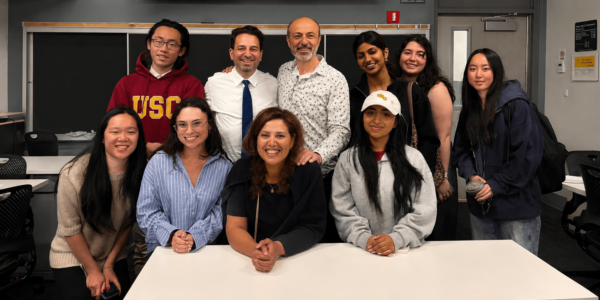

It’s a trip Steve Swerdlow has made many times: flying from Los Angeles, California to Istanbul, Turkiye and onward to Bishkek, Kyrgyzstan. Kyrgyzstan is a country Swerdlow knows well and loves deeply. He lived in Bishkek from 2012 to 2019 while working for Human Rights Watch and fully immersed himself in the city’s rhythms – literally, Swerdlow is a jazz pianist and played regularly while living in Kyrgyzstan. He continued to visit in the years after, having transitioned into a job as a professor at the University of Southern California (USC).
On May 19, it was in that role – as a professor, but also a tour guide and translator – that Swerdlow landed once more at Manas International Airport north of Bishkek with 16 USC undergraduate students in tow.
His students lined up behind him in the passport queue and then, at around 4:30 am, everything went sideways.
Almost immediately, Swerdlow told The Diplomat, he was taken out of the line and led to a small office in the departures area on the airport’s second floor. There three border officers – “almost gleefully” – told him that he was banned from entering Kyrgyzstan.
When pressed for an explanation, the officers deflected, telling Swerdlow that they were only the “implementers” and that they did not have any information about why he was being denied entry. Several different officers said he would be given an official, written deportation order that would state the reason for his denial, as required by law.
The only hint he was given was a comment from one of the officers that he’d been put on the banned list in 2024. That year, Swerdlow had led a similar group of students to Kyrgyzstan without incident.
Swerdlow told The Diplomat that this trip has been in the works for over a year, following on from two others in 2022 and 2024 during USC’s “Maymester.” The Maymester programs enable students who might otherwise not be able to do a full summer study abroad program to travel and learn about the world first-hand.
Unfortunately, Swerdlow’s 16 students are getting a front-row view of Kyrgyzstan’s transformation from the region’s foremost democracy to just another Central Asian autocracy, where the rule of law is arbitrary enforced.
It was only later, after being escorted onto a Turkish Airlines flight and flown back to Istanbul that Turkish officials returned Swerdlow’s passport and showed him the official deportation letter.

Photo provided by Steve Swerdlow.
He wasn’t allowed to keep it – not that it contained much useful information. In the field titled “reason” there were printed just four words in Russian, reading, “Entry into the Kyrgyz Republic is closed.” Swerdlow was allowed to take a photo of the document.
Swerdlow’s students, left behind in the passport line, eventually entered Kyrgyzstan and were met by staff from the American University of Central Asia, with which Swerdlow planned portions of the trip. They’ve gone to some meetings – including with the British ambassador to Kyrgyzstan – but Swerdlow was uncertain, when he spoke with The Diplomat, how much of the planned itinerary would actually happen now.
The agenda included meetings with policymakers, government officials, NGO activists, journalists, academics, and more, as well as a yurt stay near the iconic Issyk-Kul to include Manas recitations, cooking classes, and Kok-Boru. Swerdlow had even arranged a jazz performance for May 26.
Swerdlow spoke to The Diplomat by phone from Istanbul, as he awaited a flight to Almaty, Kazakhstan, where he hopes to link back up with his students.
As of publication, the U.S. Embassy in Bishkek and the U.S. State Department have made no public statements regarding Swerdlow’s ordeal.
U.S. citizens technically have visa-free access to Kyrgyzstan for stays of up to 30 days; Kyrgyz citizens, meanwhile, are subject to extraordinary scrutiny in acquiring visas to visit the U.S., including a new requirement to pay a bond of up to $15,000 in order to be issued a visa.
Kyrgyzstan has not revoked its visa-free policy for Americans and Swerdlow still has not been given an official explanation for his deportation.
Over the years, Kyrgyzstan has periodically banned foreign human rights activists and journalists, usually without notice and rarely with a clear explanation. Human Rights Watch’s Mihra Rittmann was declared persona non grata and banned in 2015 and British journalist Chris Rickelton was denied entry in 2017. In 2021, there was chatter that Bishkek was reviewing its bans on the two but that chatter fizzled into silence as Kyrgyzstan’s human rights standing deteriorated further.
Author

Related Posts
Iran war live: Tehran says US must ensure Israel ends attacks on Lebanon
Iranian deputy foreign minister says Iran ‘ready to move forward’ on diplomacy with US, but war must end on all fronts.
Read out all
In pictures: Thai Princess Bajrakitiyabha dies at age 47
Thailand's royal household has announced the death of Princess Bajrakitiyabha, the eldest daughter of King Vajiralongkorn, at the age of 47. She...
Read out all
Japan raises interest rate to highest for 31 years
Japan's central bank has increased its main interest rate to a new 31-year high after a surge in global energy prices. On...
Read out all
A year on, six questions still haunt the Air India crash investigation
A year after Air India Flight 171 to London crashed into a medical college campus moments after take-off from the western Indian...
Read out all
Delhi’s temperature showed 43.5C. Why did it feel hotter?
For several weeks now, the Indian capital, Delhi, has been battling a severe heatwave, with temperatures routinely rising above 40C. The real...
Read out all
Vincent’s parents ‘never say he’s good enough’ – so he turned to a middle-aged couple online
During mealtimes, Vincent Zhang, a tech worker in Shanghai, has a habit of whipping out his phone to check on his "virtual...
Read out all