

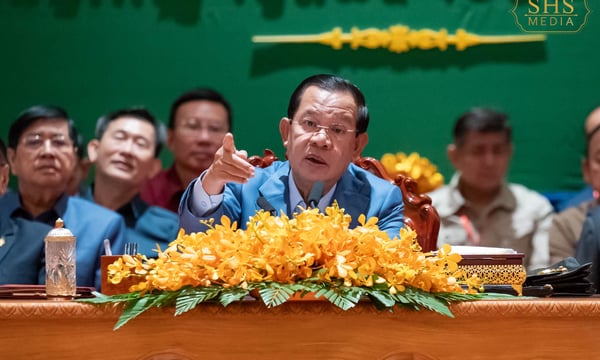

Cambodian Senate President Hun Sen speaks about efforts to combat online scams during a meeting of senior government officials in Phnom Penh, Cambodia, May 24, 2026.
In Cambodia, as elsewhere, few political developments can be understood in isolation. Two events in particular over the last 24 hours are worth reading together.
First came an unusually forceful statement from Hun Sen, Cambodia’s former prime minister, current Senate president, and still-dominant political figure, about online scam networks. In his remarks, Hun Sen urged authorities not only to arrest those directly involved in online fraud operations, but also to pursue officials who profit from them. Soon after came the announcement of a royal pardon for Kem Sokha, the former president of the Cambodia National Rescue Party and the country’s most visible imprisoned opposition figure.
For Kem Sokha, his family, and those who have stood with him through years of political persecution, the pardon cannot be viewed cynically. His case has long symbolized the Cambodian government’s systematic dismantling of democratic opposition. A 27-year treason sentence, imposed after a prosecution widely understood as politically motivated, was a message to every Cambodian who might imagine a political future outside the ruling party’s control. His family, colleagues, and supporters have lived for years under the shadow of that message. Any easing of that burden matters.
But recognition of the human significance of the pardon should not lead to analytical confusion. Kem Sokha’s pardon does not mean Cambodia is reforming. It does not undo the destruction of the opposition, restore civic space, or resolve the broader system of political repression that his prosecution illustrates. Notably, the pardon does not even lift all of the restrictions that continue to limit his political life. The opposition remains fragmented, constrained, and exiled; Cambodia’s political system remains fundamentally closed.
The same caution applies to Hun Sen’s new rhetoric on online scams. This is the same Hun Sen who made Chen Zhi, the head of Prince Group, a cabinet-level official and who provided political top-cover for elite-driven illegal logging, land grabbing, and other illicit economies long before the rise of “Scambodia.”
Yet, his statement is important. It is perhaps his strongest public acknowledgment to date that scam networks are not simply a matter of isolated criminality, but a problem involving protection and official complicity. His own exceptionally close linkages to that complicity notwithstanding, that posture shift matters. In just a few years, Cambodia has become one of the most important global hubs for industrial-scale online fraud, forced criminality, and trafficking-linked scam operations. It also matters because the Cambodian government has spent years treating any outside scrutiny of the scam economy as a reputational problem to be managed (or at least yelled at) rather than as a structural crisis rooted in endemic elite impunity.
Still, the key question is less whether these two developments matter than what they signify.
The answer is that Hun Sen is making moves.
The first move is domestic. In both the statement and the pardon, Hun Sen reasserts his role as a central power broker in Cambodia. Hun Sen issued the anti-scam statement. Hun Sen issued the pardon. The generational political transition in Cambodia exists in institutional form, but the events of the past day are a reminder that decisive political authority still runs through one man.
All this matters for international policy. Analysts and diplomats sometimes speak as though Cambodia has entered a post-Hun Sen era in which reforms might be coaxed out of a younger leadership team. There may be tactical differences within the ruling coalition, and Hun Manet’s government has shown a keener interest in managing Cambodia’s international image. But the deeper structure remains what it was during Hun Sen’s 38 years in power: personalized, authoritarian, patronage-based, and intolerant of genuine political competition.
The second move is external. International pressure on Cambodia is intensifying. The country’s role in the global scam economy has become much harder for the party-state to deny, obscure, or repress out of view. Scam compounds are now understood not only as sites of fraud, but as state-abetted nodes in a wider system of forced criminality, money laundering, corruption, and transnational organized crime.
And Cambodia’s scam economy did not emerge in a vacuum. It represents a digitally mediated extension of an older political economy in which connected actors, private security networks, corrupt officials, and transnational criminal groups operated with extraordinary latitude.
This is why the scam industry and political repression should not be treated as separate issues. The same system that crushes opposition politics also creates the conditions in which criminal actors can operate with protection. The same concentration of power that makes meaningful democratic accountability impossible also makes genuine anti-corruption and anti-crime reform exceedingly difficult. A state that cannot tolerate independent political competition is unlikely to tolerate an independent investigation into the officials and elites who enabled one of the world’s largest cyber-fraud economies.
This was the central point I tried to make in my Congressional testimony last week: scam compounds are only the visible front end. The more serious threat is the political architecture that protects them. In Cambodia, that architecture is not incidental. It is bound up with the country’s ruling order, its patronage networks, and its external alignments.
That does not mean every Cambodian official is complicit. Nor does it mean engagement is pointless. It means engagement must be clear-eyed. Tactical gestures should be welcomed only insofar as they open space for measurable action. Hun Sen’s moves this week create the appearance of space while preserving the underlying system. They invite foreign governments to welcome “progress,” deepen cooperation and legitimization, and suspend disbelief about the nature of the regime.
This has been the defining cycle of Western engagement in Cambodia for over 30 years and another round will yield more of the same. The right lesson from this moment is that pressure is working. And because pressure is working, it should be sustained and sharpened.
This is a moment to press harder: for political freedom, for accountability, and for the dismantling of the criminal architecture that has allowed Cambodia’s internal impunity to become a source of global harm.
Hun Sen understands power, pressure, and timing. It’s time for the international community to respond in kind.
Author

Related Posts
Iran war live: Tehran says US must ensure Israel ends attacks on Lebanon
Iranian deputy foreign minister says Iran ‘ready to move forward’ on diplomacy with US, but war must end on all fronts.
Read out all
In pictures: Thai Princess Bajrakitiyabha dies at age 47
Thailand's royal household has announced the death of Princess Bajrakitiyabha, the eldest daughter of King Vajiralongkorn, at the age of 47. She...
Read out all
Japan raises interest rate to highest for 31 years
Japan's central bank has increased its main interest rate to a new 31-year high after a surge in global energy prices. On...
Read out all
A year on, six questions still haunt the Air India crash investigation
A year after Air India Flight 171 to London crashed into a medical college campus moments after take-off from the western Indian...
Read out all
Delhi’s temperature showed 43.5C. Why did it feel hotter?
For several weeks now, the Indian capital, Delhi, has been battling a severe heatwave, with temperatures routinely rising above 40C. The real...
Read out all
Vincent’s parents ‘never say he’s good enough’ – so he turned to a middle-aged couple online
During mealtimes, Vincent Zhang, a tech worker in Shanghai, has a habit of whipping out his phone to check on his "virtual...
Read out all