

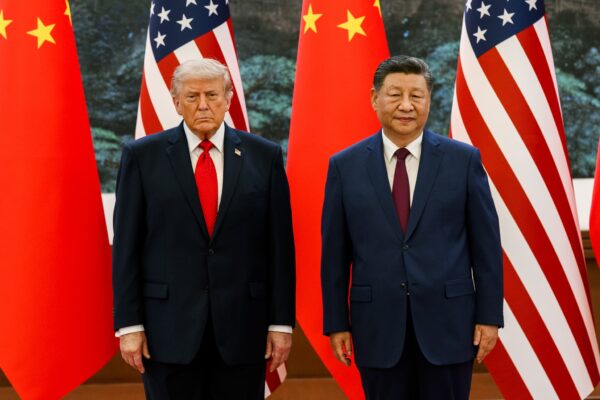

U.S. President Donald Trump participates in a welcome ceremony with President Xi Jinping of the People’s Republic of China at the Great Hall of the People in Beijing, China, May 14, 2026.
Credit: Official White House Photo by Daniel Torok
The U.S.-China summit held in Beijing on May 14, 2026 has made it clear what shape U.S.-China relations will take for the remainder of the second Trump administration. Most notably, the term “constructive and stable strategic relationship” announced by the Chinese in agreement with the U.S. is likely to carry a host of implications.
Beijing had previously proposed a “new type of major-country relationship,” in which China and the U.S. would respect each other’s core interests, a state that the Chinese seemingly felt that the then Obama administration had accepted to some extent. However, bilateral relations deteriorated considerably toward the end of Obama’s time in office, and then the shape of relations became noticeably blurred during Trump’s first term in office. At the time, Japan was enjoying good relations with Washington, while China had normalized relations with Japan. That led to the famous episode when Chinese President Xi Jinping asked then Japanese Prime Minister Shinzo Abe to convey Beijing’s intentions to Trump. Years later, and not much has changed.
With the inauguration of the Biden administration, China hoped to revive the new type of major-country relationship that it had managed to put in place with the Obama administration. It proved unable to do so. Rather, the relationship came to be framed as a “competitive relationship,” where the two sides agreed that they would avoid conflict, they would cooperate where possible, and that dialogue would be continued to properly manage relations. Under Biden, China and the U.S. worked together in areas such as climate change, while also holding a dialogue on national defense, diplomacy, and trade. Of particular note was the use of the keywords “no conflict” in this new type of international relations. Meanwhile, in the context of U.S.-China relations under Biden, Japan revived the term “mutually beneficial relationship based on common strategic interests” with China, describing the relationship as building constructive and stable relations.
Since Trump returned to office, however, it has become a major stretch to argue that the shape of Biden-era U.S.-China relations has been maintained. To begin with, Secretary of State Marco Rubio was banned from entering China during his time as a senator. Exchanges over tariffs and other issues subsequently continued, but from around 2025, ministerial-level exchanges gradually became more frequent, and so steadily lent form to U.S.-China relations in Trump’s second term. The recent summit has now added some more clarity. Although the competitive relationship persists, it consists of preventing conflict and managing the relationship while eschewing any intensification of competition, which might explain the use of the term “constructive and stable strategic relationship.”
Nonetheless, it makes little sense to view this as a return to the Biden days. What matters most is what Xi reportedly said on Taiwan, which was reportedly that “‘Taiwanese independence’ and peace in the Taiwan Strait are fundamentally incompatible. Maintaining peace and stability in the Taiwan Strait is the greatest common denominator between China and the United States.” That is, having emphasized the term “constructive and stable strategic relationship,” Xi stressed that if there is anything that may overturn that “stability,” it is Taiwan. His choice of words goes far beyond previous mentions of red and bottom lines concerning the Taiwan issue.
Today, the biggest cause of deteriorating Japan-China relations is Taiwan. The relationship between Prime Minister Sanae Takaichi and the Democratic Progressive Party government in Taiwan — and particularly President Lai Ching-te — is being closely watched, and Beijing’s objections to Takaichi’s remarks of November 7, 2025 center squarely on the Taiwan Strait. China holds that Takaichi is interfering in Chinese internal affairs through suggestions of armed force. Xi’s Taiwan-related remarks at the U.S.-China summit should be thought of as pressure on Lai, especially in anticipation of the presidential election in January 2028. The Chinese likely think of this as applying pressure on Takaichi as well.
Nevertheless, Takaichi’s government has made it clear that it has made no changes to the Taiwan policy that has been in place since the normalization of diplomatic relations between Japan and China in 1972. Even so, contrary to Japan’s intentions, Chinese policy toward Japan is likely to become even more severe, with an eye to the Taiwan issue and premised on relative stability in the U.S.-China relationship.
Author

Related Posts
Iran war live: Tehran says US must ensure Israel ends attacks on Lebanon
Iranian deputy foreign minister says Iran ‘ready to move forward’ on diplomacy with US, but war must end on all fronts.
Read out all
In pictures: Thai Princess Bajrakitiyabha dies at age 47
Thailand's royal household has announced the death of Princess Bajrakitiyabha, the eldest daughter of King Vajiralongkorn, at the age of 47. She...
Read out all
Japan raises interest rate to highest for 31 years
Japan's central bank has increased its main interest rate to a new 31-year high after a surge in global energy prices. On...
Read out all
A year on, six questions still haunt the Air India crash investigation
A year after Air India Flight 171 to London crashed into a medical college campus moments after take-off from the western Indian...
Read out all
Delhi’s temperature showed 43.5C. Why did it feel hotter?
For several weeks now, the Indian capital, Delhi, has been battling a severe heatwave, with temperatures routinely rising above 40C. The real...
Read out all
Vincent’s parents ‘never say he’s good enough’ – so he turned to a middle-aged couple online
During mealtimes, Vincent Zhang, a tech worker in Shanghai, has a habit of whipping out his phone to check on his "virtual...
Read out all