

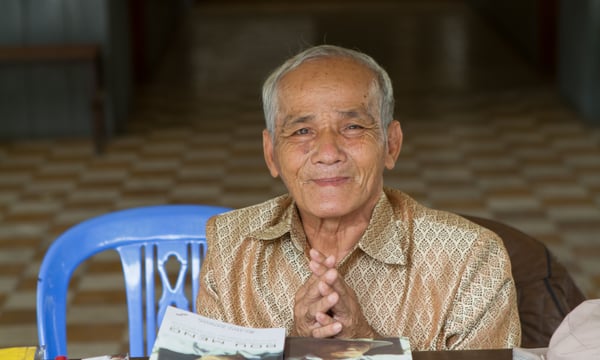

Bou Meng sells copies of his autobiography at Tuol Sleng Genocide Museum in Phnom Penh, Cambodia, Mar. 17, 2013.
Credit: Wikimedia Commons/Shay Haas
The Cambodian artist Bou Meng, one of the few known survivors of the notorious S-21 security prison in Phnom Penh, has died at the age of 85, severing another living connection to the worst atrocities of the Khmer Rouge.
The Extraordinary Chambers in the Courts of Cambodia (ECCC), a U.N.-backed tribunal that has tried a handful of former Khmer Rouge leaders for genocide and other crimes against humanity, said in a statement that Bou Meng died at 11:00 p.m. on Friday “due to age-related illness.”
“The passing of Mr. Bou Meng represents the loss of an important historical witness to the grave crimes committed during the brutal Khmer Rouge regime, particularly to the history and tragedy that took place at the former S-21 Security Centre,” the ECCC stated.
Bou Meng was one of 14,000-plus men, women, and children who were sent to S-21 during the 1975-1979 rule of Democratic Kampuchea, as the Khmer Rouge state was officially known. After taking power in April 1975, the Khmer Rouge made a mad dash towards agrarian utopia, emptying most of the cities and towns, and putting Cambodians to work on grim rural labor communes. During its three years, and eight months, and 20 days in power, the Khmer Rouge caused the deaths of an estimated 1.7 million people, through disease, starvation, and execution.
S-21, also known as Tuol Sleng, was built in a high school in the southern suburbs of Phnom Penh and served as the nerve-center of the regime’s fearsome security apparatus. Nearly all of those sent to S-21 were interrogated, forced to sign mostly false confessions, and then executed at a “killing field” on the city’s outskirts. Only seven adult prisoners were known to have got out alive.
As he recounts in his memoir, “Bou Meng: A Survivor From Khmer Rouge Prison S-21,” in 1977, Meng was arrested and accused of spying for the United States and held for two years at S-21. Like Vann Nath, another artist who survived S-21, Meng escaped execution only because of his skill as a painter, and was put to work producing propaganda portraits of the Khmer Rouge leader, “Brother Number One” Pol Pot, and other officials. However, this did little to save his wife Ma Yoeun and two children, all of whom perished under the Khmer Rouge.
Bou Meng, along with Vann Nath and Chum Mey, a mechanic, were spared because he could repair the prison’s sewing machines, testified in 2009 at the ECCC trial of Kaing Guek Eav, aka Comrade Duch, a former schoolteacher who served as the prison’s commandant.
During his testimony, Meng recalled the torture he experienced after his arrival in Tuol Sleng. He told the court that prisoners were kept in chains with empty bullet boxes and plastic bottles to use as toilet.
“I saw about 20 men with long hair, looking very sick and emaciated. The cell was like hell on earth,” Meng told the court. “I saw a lizard and hoped it would drop on me so I could catch it and eat it,” he added. “They kept whipping me and asked me when I joined the CIA.”
Meng was given a lifeline when S-21 officials sought a painter among the detainees to produce a portrait of Pol Pot. He continued to work as an artist until S-21 was liberated by the Vietnamese military after it overthrew the Khmer Rouge in January 1979.
In July 2010, the ECCC found Duch guilty of crimes against humanity and war crimes as well as homicide and torture, and sentenced him to 35 years in prison. In early 2012, a Supreme Court Chamber upheld the conviction, upping his sentence to life imprisonment. Duch died in 2022 at the age of 77.
His testimony, which was also cited in the tribunal’s second case, made a “significant contribution to the pursuit of truth and justice for victims,” the ECCC said in its statement.
In his later years, Bou Meng could often be seen at the Tuol Sleng Genocide Museum, the former site of S-21, where he sold copies of his memoir and spoke to visitors about his experiences.
Meng’s death leaves Chum Mey as the only living adult survivor of S-21.