

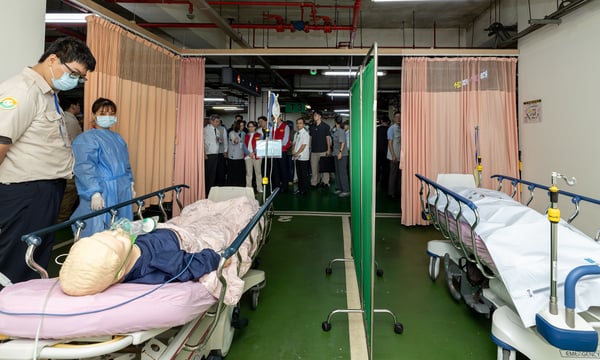

Taiwan’s Vice President Hsiao Bi-khim (3rd from left in the background) visits an underground medical facility, as part of the Kaohsiung 2026 Urban Resilience Exercise, Aug. 7, 2026.
Credit: Office of the President, ROC (Taiwan)/ Wang Yu Ching
While deterrence is generally assessed in terms of ships, missiles, aircraft, and reservists, a Taiwan scenario will not be determined solely by such hardware. A coercive effort on the part of China could be designed to deliver a quicker political solution for Taiwan. Beijing may attempt to persuade the populace sufficiently that the Taiwanese government was incapable of protecting, informing, and supporting its citizens—all before China ever has to make an amphibious landing.
Yu-Hsuan Yeh, Bonny Lin, and Jane Nakano of the Center for Strategic and International Studies identified scenarios “short of an invasion of Taiwan” in which China could cut off energy or other key resources “via a quarantine or blockade.” Additionally, Beijing could attack Taiwan’s “power grid and energy infrastructure via cyber or kinetic means.” Disruption to power, logistics, and communications can constrain Taiwan’s ability to function before it defeats military forces outright.
The central issue, then, is not whether Taiwan can identify essential national assets — hospitals, ports, communication networks — but whether it can preserve their functions in a crisis scenario.
Taipei is increasingly preparing for this broader problem. Taiwan’s 2026 urban-resilience exercises further increased integration alongside the Han Kuang 42 exercise this year, after coinciding for the first time in 2025. Notably, 2026 marks another evolution for the Han Kaung exercises, this time bringing local government, hospitals, transport networks, emergency responders, critical infrastructure operators, and military forces into shared wartime scenarios.
The 2026 drills tested evacuation and sheltering, traffic control, emergency response, civil–military coordination, and simulated mobile-network degradation in 14 central and northern jurisdictions. The Central News Agency reported that the format expanded from one day to two, used shared civilian-military scenarios, and tested cross-jurisdictional coordination. It also included underground medical operations, medical evacuation, joint transportation, and drone-enabled supply.
A Taiwan crisis would move through roads and ports, hospitals and pharmacies, electrical substations, and communications networks. At the heart of resilience are local emergency centers, which will decide which vehicles can move, which facilities receive power, and where people are directed to shelter. During the August 6-7 Kaohsiung-Pingtung urban resilience exercise, officials combined a tabletop exercise with practical drills on organizing evacuations, distributing essential goods, protecting critical infrastructure, and opening first-aid and relief stations. The city government conducted exercise activity in 12 administrative districts and at 10 critical infrastructure sites.
During the Kaohsiung practical exercise on August 7, I observed civilian and military personnel rehearse how backup power and alternate command procedures could support emergency supply distribution under disrupted conditions. The drill illustrated that resilience depends less on any single asset than on the ability of several institutions to coordinate actions quickly when normal systems fail.
At Kaohsiung Veterans General Hospital, the exercise simulated medical load reduction to rehearse “sustaining medical care when critical infrastructure is damaged, disrupting, for example, water, electricity, or oxygen supplies.” The exercise also simulated converting f underground spaces into alternative medical functions via an activated backup command center. The drill opened underground acute-care beds, intensive-care capacity, and operating rooms, and simulated inpatient transfers and mass-casualty reception. The Military News Agency reported that the underground arrangement included triage, emergency treatment, burns isolation, an emergency pharmacy, blood bank, laboratory, medical-supply storage, food-service space, and medical evacuation.
A hospital facing a mass-casualty event, disrupted transport, or an attack on nearby infrastructure must preserve a defined package of functions. The standard should not be whether it owns a generator or possesses basement space but whether it can both activate and sustain medical care.
A generator has little operational value if it lacks fuel, a tested transfer system, maintenance, spare parts, operators, protection, and a priority list for supported loads. Likewise, an underground medical site is not a functioning alternative hospital merely because it is underground. It requires ventilation, water, sterilization, oxygen, patient routing, records, communications, staffing, security, and a way to receive and transfer patients when normal roads or receiving facilities are unavailable.
The Kaohsiung drill is therefore a useful first step, but it should lead to more measurable questions across Taiwan’s cities: How long can critical functions operate on backup power? Who can activate an alternate site? What triggers a reduction in routine medical care? How are patients directed if a hospital loses digital records or road access? How are pharmacy and blood supplies replenished under disrupted conditions?
Separately, the Qianzhen District Disaster-Prevention Coordination Center in Kaohsiung held urban resilience drills. CNA reported that the center organized civil resources and community-resilience groups into evacuation, shelter, and supply-management teams; it also rehearsed support for a relief station after a simulated bombardment in the Caoya area.
The relevant institutions were in the room for the drill, but that alone is not enough. The challenge is determining whether they have a common operating picture, an agreed-upon decision-making process, alternative communications, and clear legal authority when conditions become contested. In practice, a crisis would force decisions over road access, fuel allocation, hospital activation, supply priorities, and the use of civilian facilities. These decisions have to be lawful, fast, and able to be made when communications are incomplete and the initial plan has already failed.
This area is where Taiwan’s next exercises should become more demanding. Rather than assessing whether each agency participated, they should measure time to activate alternate care; time to reroute ambulances and military logistics after route loss; backup-power endurance; time to establish a relief site; and the ability to issue corrective public information during network degradation or false reports.
Taiwan’s civilian resilience is an operational condition for deterrence. Military aid, resupply, and crisis coordination will have limited utility if Taiwan’s hospitals, power systems, logistics networks, communications, and local authorities cannot receive, direct, and sustain them.
Han Kuang 42 does not prove that Taiwan can sustain a prolonged cross-strait conflict. A scheduled, two-day exercise cannot establish whether local authorities, infrastructure operators, hospitals, and military forces can function through repeated strikes, degraded networks, fuel constraints, damaged roads, and staff exhaustion. However, Han Kuang 42 does represent a meaningful change. Civil preparedness is being treated less as a post-strike humanitarian issue and more as part of the operational environment in which Taiwan’s forces would have to move, communicate, sustain themselves, and fight.
War games often test whether Taiwan can resist military aggression from China. The real question is whether an adversary can break Taiwan’s capacity to govern and function before Taipei and its partners can organize an effective response.