


As it struggles to ship oil through the Strait of Hormuz, Iran is looking for alternative land routes to import and export goods. In March, Iran exported 1.84 million barrels per day (BPD) to Asian customers, mostly China. Although some ships managed to evade the blockade, Iran still cannot transport as much oil as it produces each day.
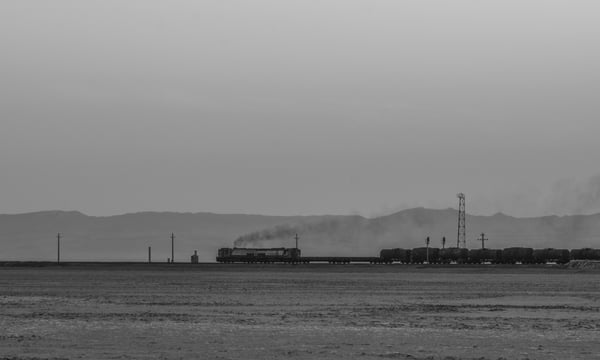
Iran is turning to railway routes through Central Asia as a safer passage for trade with China. While Iran can transport some of its oil over land by rail through Central Asia, it does not have the capability to transport the same amount as it can ship by sea. At best, moving oil over land would serve as a limited lifeline for Iran to sustain itself until the war is over.
Operating since May 2025, a 10,400-kilometer China-Iran railway corridor stretches from the Chinese city of Xi’an to Tehran. The railway passes through Kazakhstan, Kyrgyzstan, Uzbekistan, and Turkmenistan before arriving in Iran – taking approximately 15 days as opposed to a month by sea. Bloomberg reports that cargo shipments from Xi’an to Tehran have increased from one per week to “one every three to four days” since the beginning of the U.S. blockade in April.
In recent years, China, Iran, Russia, and other countries built and expanded railway routes across Central Asia. Officials from China, Kyrgyzstan and Uzbekistan announced in 2024 the long-awaited implementation of the 523-kilometer China-Kyrgyzstan-Uzbekistan (CKU) railway corridor, with China providing a $2.35 billion loan and a majority stake. In November 2025, Interfax reported that the first freight train from Russia to Iran arrived in Aprin, outside Tehran, after a 12-day journey through Kazakhstan and Turkmenistan.
According to the Central Asia-Caucasus Institute (CACI), prior to the war, Iran and Turkmenistan agreed to lay additional tracks at the Sarakhs station in northeastern Iran, bordering Turkmenistan, to increase the volume and speed of cross-border shipments. China and Iran are also collaborating on the electrification of a 1,000-kilometer railway in Iran from the city of Sarakhs to Razi, bordering Turkiye.
The route across Central Asia could present Iran with a fast-moving economic lifeline if U.S. forces further restrict passage through Hormuz. But this will not be enough to relieve Iran of the pressure of the blockade.
First, rail shipments run mostly from China to Iran, transporting industrial and consumer goods, not Iran to China. While this can be switched to allow more rail shipments to China, Iran may need to sacrifice importing goods it needs – an unlikely scenario amid the blockade.
Second, the locations of Iran’s oil fields and China’s oil refineries are not favorable to the transport and sale of Iranian oil through Central Asia. Most of Iran’s oil fields are in the south, and ships move Iran’s exported oil to the eastern coast of China to be refined in “teapot” refineries. While there are oil refineries in western and central China, they are currently refining domestic or imported oil from other countries and cannot refine as much oil as the large ones on the coast.
Third, while transporting oil by rail to China is faster and safer, the payoff is not ideal. The average shipment of oil by rail is between 60,000 and 70,000 barrels. Iran can also transport between 250,000 and 300,000 bpd if it exports oil to additional countries like Turkiye, Pakistan, Afghanistan, and Uzbekistan. In comparison, even with the risk of being caught or captured, the average tanker can move more than 600,000 barrels, and a Very Large Crude Carrier (VLCC) can transport more than 2 million barrels.
If Iran decides to send oil to China by rail (figure 70,000 barrels per shipment) at a discounted rate (between $75 and $100 per barrel), it could generate between $5.25 million and $7 million per shipment. If the number of shipments increases two to three times per week, Iran could see revenue from $10.5 million to $21 million after the two-week journey. However, there is a lack of available data showing that Iran even has the capacity to transport that much oil by rail. After dividing the revenue, it would fall short of the billions of dollars the IRGC received in oil revenue in 2025.
As the war and the blockade of the Strait of Hormuz carries on into another month, Iran has the option to transport oil to China by rail routes through Central Asia. If implemented, the plan would give Iran the ability to safely transport oil to its single largest customer in a short period of time. However, Iran will not be able to export enough oil to fully replace what it can deliver more effectively by sea. China and Iran can work together in the future to make this a more attractive option, but neither can do anything about it while the war continues. Such a plan will serve as an emergency lifeline rather than a solution for Iran’s oil headache.
Author

Related Posts
Iran war live: Tehran says US must ensure Israel ends attacks on Lebanon
Iranian deputy foreign minister says Iran ‘ready to move forward’ on diplomacy with US, but war must end on all fronts.
Read out all
In pictures: Thai Princess Bajrakitiyabha dies at age 47
Thailand's royal household has announced the death of Princess Bajrakitiyabha, the eldest daughter of King Vajiralongkorn, at the age of 47. She...
Read out all
Japan raises interest rate to highest for 31 years
Japan's central bank has increased its main interest rate to a new 31-year high after a surge in global energy prices. On...
Read out all
A year on, six questions still haunt the Air India crash investigation
A year after Air India Flight 171 to London crashed into a medical college campus moments after take-off from the western Indian...
Read out all
Delhi’s temperature showed 43.5C. Why did it feel hotter?
For several weeks now, the Indian capital, Delhi, has been battling a severe heatwave, with temperatures routinely rising above 40C. The real...
Read out all
Vincent’s parents ‘never say he’s good enough’ – so he turned to a middle-aged couple online
During mealtimes, Vincent Zhang, a tech worker in Shanghai, has a habit of whipping out his phone to check on his "virtual...
Read out all