

Pakistan’s wedding industry under strain as Middle East tensions add to economic woes
Operators say bookings have weakened and celebrations are becoming smaller as inflation, uncertainty and concerns over remittances weigh on consumers.
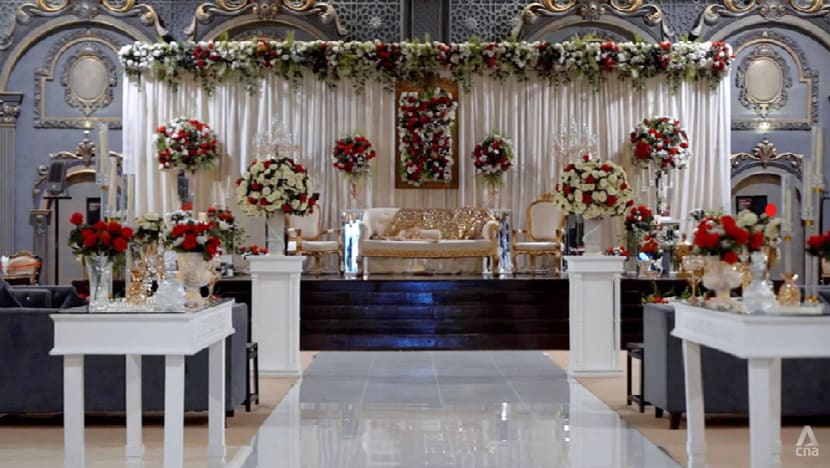
A decorated wedding stage at a venue in Rawalpindi, Pakistan. Wedding businesses say families are scaling back celebrations amid rising costs and economic uncertainty.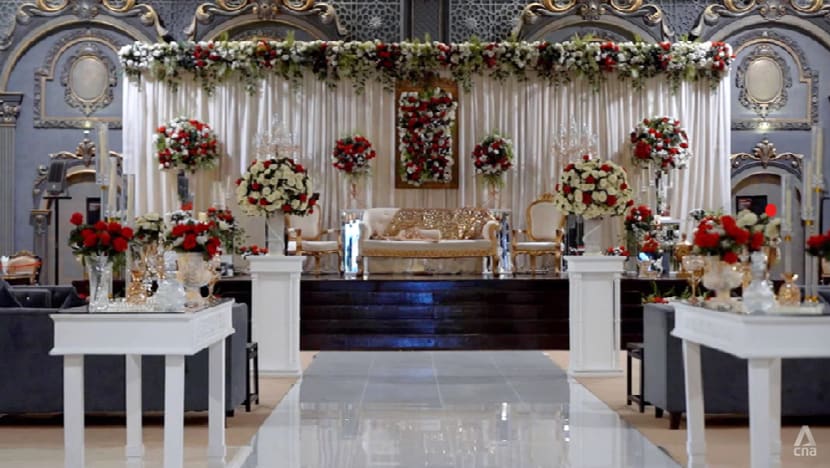
New: You can now listen to articles.

This audio is generated by an AI tool.


RAWALPINDI, Pakistan: Pakistan’s lavish wedding industry is coming under pressure as families rein in spending amid rising costs and economic uncertainty linked to the war on Iran.
Pakistani weddings are typically elaborate social events that bring together hundreds – sometimes thousands – of guests.
Families typically spend months planning outfits, food and decorations.
But businesses across the sector say the mood has shifted as customers cut back on both bookings and the scale of celebrations.
CUSTOMERS SPENDING LESS
At bridal boutique Zari Palace, located in the country’s fourth-most populous city of Rawalpindi, customers are still walking through the doors.
But owner Hassan Sheikh said many are spending more cautiously as economic uncertainty weighs on household budgets.
“We are already facing a lot of difficulties because of inflation, reduced business activity and taxes. If the Middle East crisis continues for another six to eight months, it will create a very difficult situation for all of us,” he told CNA.
Pakistan’s wedding season typically peaks between November and April, with venues and service providers often receiving bookings up to six months in advance.
Muhammad Saqib, who has operated wedding marquees for more than 20 years, says demand has weakened significantly.
“After the war (on Iran), I have become deeply worried and had to lay off workers. I cut down my staff because there is no work due to the war,” he said.





SUPPLY DISRUPTIONS ADD TO PRESSURE
Business owners say regional uncertainty is also affecting supply chains, making imported decorations harder to come by.
Many decorative items used at Pakistani weddings are shipped in through Dubai, a major logistics hub for the region.
But these supply routes have come under pressure since fighting involving Iran escalated at the end of February. A ceasefire has been in place since April, but clashes have continued and an agreement to end the war has not been reached.
Shipping companies have reported disruptions, higher insurance costs and delays as vessels navigate heightened security risks in the region.
“When the Gulf is closed, how are things going to reach us? All my decorative items come through Dubai before reaching Pakistan, but I haven’t received any shipments for the last two to two-and-a-half months,” Saqib added.
The challenges come as the Pakistani authorities continue to enforce austerity measures aimed at reducing energy consumption and discouraging excessive spending.
Authorities have imposed restrictions on wedding timings, limited guest numbers to 200 and enforced a one-dish policy at wedding events.
Industry players say those measures have further dampened demand.

DEPENDENCE ON REMITTANCES
Another major concern is remittances.
Pakistan is one of the world’s largest recipients of money sent home by overseas workers. Tens of billions of US dollars flow into the country each year, with Saudi Arabia and the United Arab Emirates among the largest sources.
These funds are a key source of foreign exchange for Pakistan and income for millions of households.
Economists say remittances play an outsized role in supporting Pakistan’s economy, particularly as the country continues to struggle to generate sustained export growth.
“We have to have these remittances because we are not increasing our exports. In the near future, there’s no such evidence that we can double our exports. Remittance is actually a backbone to foreign exchange,” said Nasir Iqbal, a professor of economics at the Pakistan Institute of Development Economics, an Islamabad-based think-tank.
Data from the State Bank of Pakistan showed remittances eased in April from the previous month, raising concerns among businesses that households may become more cautious with discretionary spending such as weddings.
The impact is far-reaching as the wedding industry supports a wide network of businesses from caterers and decorators to photographers and tailors.
With inflation running high, many firms are worried that future wedding seasons may not bring the same level of spending they once relied on.




Author

Related Posts
Iran war live: Tehran says US must ensure Israel ends attacks on Lebanon
Iranian deputy foreign minister says Iran ‘ready to move forward’ on diplomacy with US, but war must end on all fronts.
Read out all
In pictures: Thai Princess Bajrakitiyabha dies at age 47
Thailand's royal household has announced the death of Princess Bajrakitiyabha, the eldest daughter of King Vajiralongkorn, at the age of 47. She...
Read out all
The unknown man in my mother’s coffin: A year after Air India crash, families still waiting for answers
Miten Patel remembers the day hospital staff in Ahmedabad drew two vials of his blood to help identify his parents. He had...
Read out all
Japan raises interest rate to highest for 31 years
Japan's central bank has increased its main interest rate to a new 31-year high after a surge in global energy prices. On...
Read out all
A year on, six questions still haunt the Air India crash investigation
A year after Air India Flight 171 to London crashed into a medical college campus moments after take-off from the western Indian...
Read out all
Delhi’s temperature showed 43.5C. Why did it feel hotter?
For several weeks now, the Indian capital, Delhi, has been battling a severe heatwave, with temperatures routinely rising above 40C. The real...
Read out all