

- 0
- 916 words
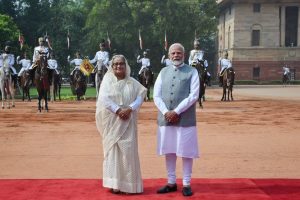
A file photo of then-Bangladeshi Prime Minister Sheikh Hasina with her Indian counterpart Narendra Modi during her visit to New Delhi, India, weeks before her ouster from power in 2024.
Credit: Facebook/Ministry of External Affairs, Government of India
New Delhi’s decision to allow deposed Bangladesh Prime Minister Sheikh Hasina to hold a press conference on August 5, coinciding with the second anniversary of the toppling of her government in a student uprising in 2024, has set back India’s ties with the Bangladesh Nationalist Party (BNP) government in Dhaka.
What is most intriguing is the timing. Ties with the Tarique Rahman-led government were on the mend as Bangladesh Foreign Minister Dr. Khalilur Rahman visited New Delhi from April 7 to 9, marking the first high-level ministerial engagement. India too had sent an invitation to Prime Minister Rahman to attend the BRICS summit to be held in New Delhi in September. Bilateral trade and the issuing of visas to Bangladeshi citizens had resumed. The appointment of Dinesh Trivedi, a senior politician, as India’s new high commissioner was seen as a thawing of frozen ties.
All these measures took a hit when Sheikh Hasina was allowed to hold a press conference. India’s foreign ministry distanced itself from the event, with a ministry spokesman saying the government had no role to play in what was an event by a private media entity, and that the government does not endorse anything said at the forum. Even so, especially with regard to the duly constituted government of Bangladesh, the damage was done.
The press event prompted a furious reaction from Dhaka. The government expressed deep outrage and regret, describing the incident as a direct affront to the sovereignty of Bangladesh and a grievous insult to the martyrs of the July Revolution. The foreign ministry press note further warned of the severe ramifications such a public platform could have on the reset and restoration of bilateral relations. Bangladesh has already sought Sheikh Hasina’s extradition under the 2013 India-Bangladesh Extradition Treaty.
Hasina’s son Sajeeb Wazed Joy further aggravated the situation by calling Bangladesh a “failed state” and saying it could emerge as a hub for regional terrorism. Speaking virtually from the United States at the Foreign Correspondents’ Club event in New Delhi, he alleged that Pakistan’s Inter-Services Intelligence (ISI) was operating freely in Bangladesh and accused the current government of allowing the release of hundreds of convicted militants jailed during the Awami League’s rule.
Joy also claimed that banned Islamist organizations such as Hizb ut-Tahrir were now openly holding rallies and that individuals linked to al-Qaida had addressed public gatherings. Describing the situation as a direct security threat to India, he said Bangladesh was becoming “another Pakistan” on India’s eastern frontier, warning that the country’s growing instability would have consequences not only for India but for the wider region.
By giving Sheikh Hasina and her son a platform to lash out at the present regime from Indian soil, India has sent a signal to Dhaka that it still stands with its old friend — Hasina.
Although it goes without saying that India must have calculated the political cost of the event, on the face of it, it looks like India, with one stroke, has brought all efforts to mend ties to naught.
The reason for having friendly ties with the regime is that Bangladesh is India’s second-biggest trading partner in the region and its geographical location is also important for India’s strategic interests.
Speaking to Al Arabiya English, senior analyst Derek Grossman described Sheikh Hasina’s ouster as “a major blow to Indian strategy,” creating a diplomatic irritant and setback for New Delhi’s regional security framework.
This became apparent when Prime Minister Rahman chose China over India for his first foreign visit, where he signed an MoU with China Civil Engineering Construction Corporation (CCECC), a Chinese state-owned company, to develop the China-Bangladesh Mongla Port Economic Zone. The Chinese proposal is reportedly worth about $650 million and includes attracting Chinese manufacturing, developing bonded warehouses and turning the area into a logistics hub.
The crucial point for India is that this land had originally been earmarked for an Indian economic zone. Mongla itself is Bangladesh’s second-largest seaport, and India has had significant strategic and commercial interest in it as it is strategically located in southwestern Bangladesh, close to the Bay of Bengal and India’s eastern seaboard. According to Bangladeshi sources, 12 Chinese companies have proposed investments totaling $9.21 billion following Rahman’s visit to China.
The second is the newfound bonhomie between Dhaka and Islamabad. Under Hasina, relations with Pakistan were severely constrained by the 1971 Liberation War legacy and war crimes trials of domestic pro-Pakistan actors like Jamaat-e-Islami.
As a result, defense cooperation between Pakistan and Bangladesh has seen a sudden acceleration.
In January 2025, a six-member Bangladeshi military delegation led by Lieutenant General SM Kamrul Hasan visited Pakistan and held meetings with the chiefs of Pakistan’s three armed services.
Then the air chiefs of Bangladesh and Pakistan held talks in Islamabad in January 2026 on possible procurement of Pakistan’s JF-17 Thunder fighter aircraft.
Before giving Hasina the platform, the Indian government should have considered that the present dispensation in Dhaka is antagonistic towards India.
Calling India’s position contradictory, Bangladesh Home Minister Salahuddin Ahmed said that giving Hasina a political platform and seeking friendly ties cannot go together.
Only time will tell the implications of this fallout, but on the face of it, it looks like a miscalculated move.
Author
