
- 0
- 1,105 word
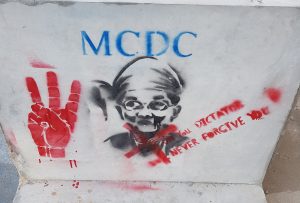
Anti-junta graffiti seen during anti-coup protests in Mandalay, Myanmar, Feb.9, 2021.
Credit: Wikimedia Commons/Kantabon
Across Southeast Asia, artists and cultural rights defenders are increasingly being cast as threats – to public morality, political order and dominant narratives about gender, sexuality, identity, and belonging.
This is especially true for queer and trans artists, whose bodies, stories, and performances often challenge the boundaries that states, religious authorities, and conservative movements seek to impose. When they are surveilled or attacked, or their work is censored, the consequences touch the foundations of civic space: the right to speak, gather, remember, imagine, and contest power.
ArtsEquator’s Southeast Asia Artistic Freedom RADAR Database documents this reality across Cambodia, Indonesia, Malaysia, Myanmar, the Philippines, Thailand, and Vietnam. In its 2025 report, RADAR recorded 159 challenges to artistic freedom across the seven countries. The findings closely mirror those of the CIVICUS Monitor, which rated Myanmar and Vietnam as “Closed,” Cambodia, Thailand, and the Philippines as “Repressed,” and Malaysia and Indonesia as “Obstructed.”
This matters because attacks on artistic freedom often serve as warnings about the health of civic life. Where artists are censored, surveilled, attacked, or forced into silence, broader patterns of repression are already at work.
While navigating the RADAR database, I came across “moral policing” as a category of violations faced by artists and cultural rights workers. In practice, moral policing punishes artists and communities whose work challenges artificial boundaries around gender, sexuality, faith, tradition, or national identity. It does not always manifest as an outright ban or formal legal charge. More often, it takes shape through public accusations, social pressure, police scrutiny, cancelled performances, restrictions on distribution, withdrawal of support, online harassment, physical attacks, surveillance, or the destruction of artworks.
As I dug deeper, it became evident how often LGBTQ activism and artistic expression appeared in work targeted by this category. This mirrors a trend Urgent Action Fund Asia and Pacific (UAF A&P) has been recording across its learning reports: that queer, trans and LGBTQ communities across Asia and the Pacific are increasingly being targeted through legislation, political and social attacks, isolation, and reduced resources for activism.
This broader pattern of moral policing and restrictions on cultural expression is visible in specific cases. In Vietnam, RADAR recorded 22 challenges to artistic freedom in 2025, almost double the number documented in 2024. Official Dispatch 69, issued by the Ho Chi Minh City Party Committee’s Propaganda and Mass Mobilization Department in October 2025, called for stricter measures against musical activities showing signs of “deviating from the cultural standard.” Although the dispatch did not formally ban any of the named songs or artists, it triggered a chain of reactions, including the removal of music videos from YouTube by several performers.
Vietnam also saw the targeting of VietPride in 2025. Just two days before its flagship rainbow march in Ho Chi Minh City, VietPride announced the event had been cancelled due to “external reasons.” According to RADAR, at least five other VietPride-related events in the city faced last-minute cancellations or restrictions.
RADAR’s latest report notes that, in 56 percent of cases, works or creators were portrayed as having transgressed imposed boundaries of morality, traditional values or customs, gender, sexuality, or faith, and were subjected to moral policing by state and non-state agents.
“Manufactured conflicts and moral panic over minorities, migrants, and perceived threats to traditional values have put artists at the front line of state and public attacks,” says Kathy Rowland, lead researcher for RADAR.
For artists whose identities and practices already challenge dominant norms, the pressure is intensified. Serena Magiliw, a trans actor and theatre artist from the Philippines, describes how this pressure shapes both her art and her survival.
“It is sad to know that our lives are so intertwined with being policed and surveilled because we are the embodiment of resistance,” she says.
For Magiliw, the struggle is cultural, political, and deeply economic. “I perform for a living. And if I don’t have the space to do that, I won’t survive,” she said. “I can only offer my service, which is art.”
Her words show that moral policing effectively controls whose lives are allowed to be visible, whose histories can be told, and whose futures can be imagined.
Despite these threats, artists continue to persist, finding ingenious ways to build community, extend care, and sustain resilience. Their work reaches beyond survival. It preserves memory and the legacies of hard-fought struggles, reminding new generations on the frontlines of rights movements of the ground that had once been claimed.
Resistance can leave its own mark. In 2025, Filipino drag artist Pura Luka Vega was acquitted by a Manila court of charges related to a 2023 drag performance that prompted an intense backlash from religious groups. The acquittal did not erase the cost of the ordeal, but it offered a hard-won reminder that artists and communities can push back.
In these contexts, artists are often doing work traditionally associated with human rights defenders – but without the same legal, institutional, or community-led support and protection. UAF A&P has recognized this through its Shifting Narratives program, which supports artists and cultural rights workers challenging harmful narratives affecting their communities and connects artist-activists with wider networks of rights defense and community care.
Another artist working within a highly surveilled Southeast Asian state, whose name and identity are being withheld for security and confidentiality, wrote about the relevance of their group’s work in protecting historical legacies from being censored, eradicated and expunged.
“This [work] is also about preserving memory, rather than being entirely dependent on algorithms, censorship, and platform logics. And more importantly, it’s about protecting our labor,” the artist says. “When carefully written and designed work gets deleted without a trace, it’s not just frustrating; it’s one of the reasons many activists feel exhausted. For us, this is also a form of ‘memory infrastructure’ under platform authoritarianism.”
That phrase – memory infrastructure – captures something vital about the role of artists in shrinking civic spaces. In places where public narratives are controlled, archives are fragile, platforms are unpredictable, and dissent is punished, artists help communities remember. They protect stories from disappearance. They create languages for grief, resistance, longing, and survival.
Hope and community are often the only enabling conditions under which most of these artists persist and resist. Yet at a time when all trends point to growing authoritarianism and moral policing in Southeast Asia, and to shrinking tolerance for dissent and minority expressions, art and culture remain the neural systems through which communities preserve and transmit their stories and truths.
When artists are silenced, a community loses one of its ways of imagining, and insisting on, a different future.
Author
