
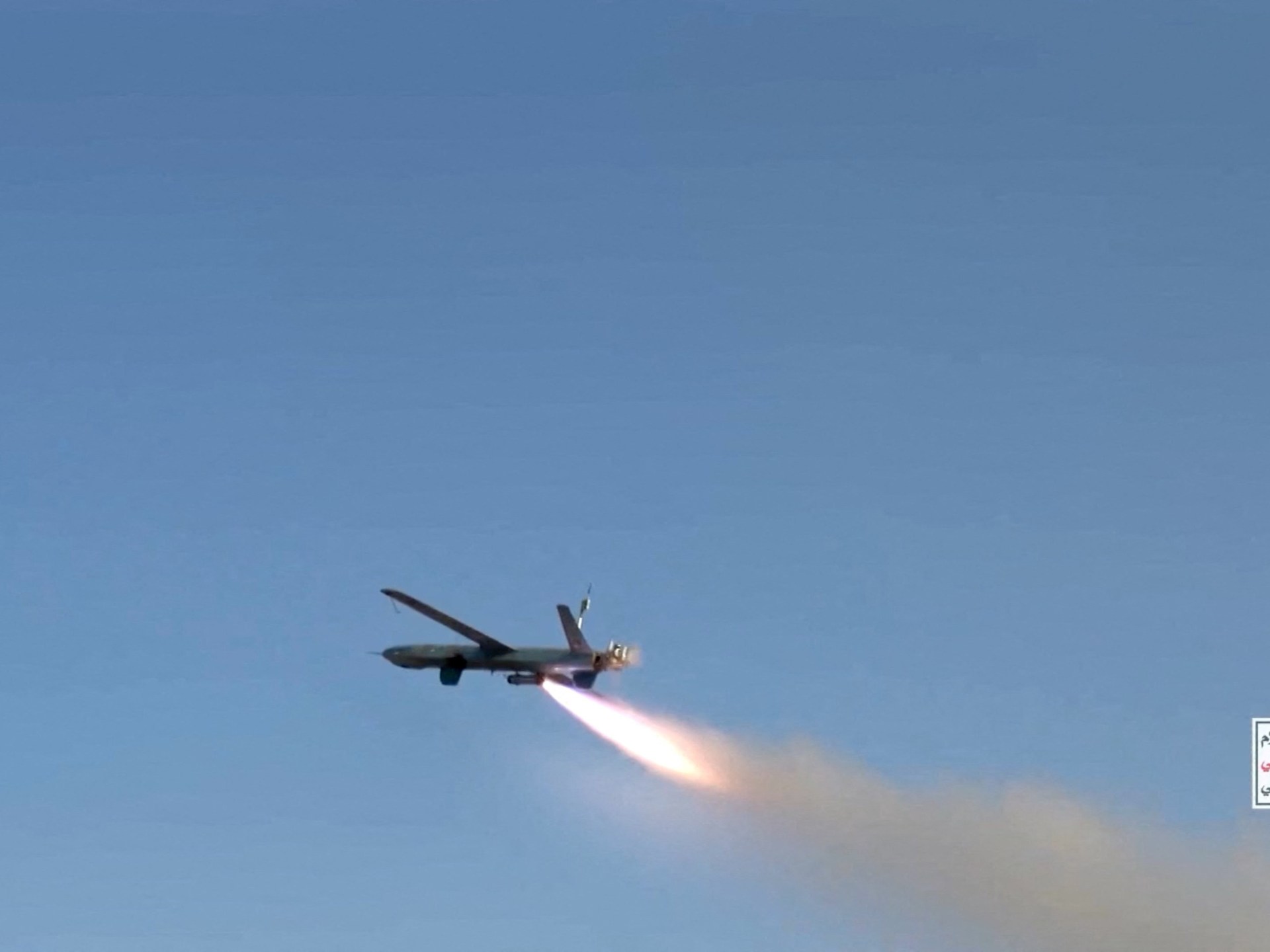


As the conflict in Yemen rages on and spills over into the Red Sea, developments in recent weeks reveal a new trend worth pondering. The Houthis group, which for years almost monopolised the advantage of drone warfare, has begun facing fire from the same weapon used by its opponents on multiple fronts.
This does not mean that the balance of power has shifted, or that the Houthis have lost their missile and drone superiority. However, the increasing use of this type of warfare by the forces loyal to the internationally recognised government may change the nature of the confrontation, especially if it shifts from scattered operations to an organised and sustained capability.
Recommended Stories
list of 2 items
- list 1 of 2Yemen’s government says Houthi attack on al-Makha kills at least four
- list 2 of 2Houthi attack on port kills four eroding truce with Yemen’s government
end of list
For years, the Houthis were able to use drones as one of the most important weapons of asymmetric warfare. They were able to monitor their opponents and strike their gatherings, command centres and facilities far from the lines of contact, while government forces were mostly in a position of defence and interception.
Today, the equation is no longer that simple.
Forces affiliated with the government have announced in recent days the use of drones against Houthi positions in Marib, al-Jawf, Taiz, Hajjah, al-Dhalea and other fronts – and have shown video of a number of those operations.
It is not yet possible to speak of parity in drone power. The Houthis have years of experience and a more advanced missile and drone infrastructure. However, the government does not necessarily need full parity in order to bring about change on the battlefield.
It is enough for Houthi gatherings, vehicles, artillery, reinforcements and command centres to become vulnerable to strikes for them to be forced to change their patterns of deployment, movement and supply. In war, forcing the enemy to change its behaviour is in itself a military achievement.
It would be wrong to say that the Houthis have moved onto the defensive. They are carrying out broad offensive operations: they have struck Marib and Hadramout, repeatedly targeted al-Makha (Mocha), escalated against Saudi Arabia and once again moved their operations to the Red Sea and Bab al-Mandeb.
But there is a difference between the group being on a strategic defensive and beginning to act on some fronts as though it must prepare for a possible attack.
Here, the geography of the recent strikes becomes more important than their number.
Marib, Taiz, al-Makha and the western coast are not random fronts; they represent key gateways for any potential ground war.
Marib is the gateway to the east and one of the government’s most important military and political centres of gravity. Striking camps and movements there not only causes losses, but can also expose deployments, defences, response speed and sources of reinforcement.
Taiz is the central and coastal junction. Activating its fronts can pin down large forces and prevent their easy redeployment towards the western coast or other fronts.
Al-Makha and the western coast carry a different significance. South of the city lies Bab al-Mandeb and to the north the road extends towards Hodeidah. Therefore, the repeated targeting of al-Makha with missiles and drones can also be seen as a test of a front that could become very important if a ground operation begins along the coast.
When we combine what is happening in Marib, Taiz, al-Makha, al-Dhalea, al-Jawf, Saada and Hodeidah, it becomes difficult to view each front as a separate incident.
This does not mean that the decision for a ground war has been made, but it does mean that the parties have begun to act as though this possibility must be taken seriously.
For this reason, the most important indicator in the coming period will not be the number of missiles or drones, but the movement of forces and reserves, and the transfer of ammunition.
When this movement begins to concentrate on a specific axis, we will have moved from testing the front to preparing the front.
It is precisely in this context that the recent statements of Presidential Leadership Council Chairman Rashad al-Alimi should be understood.
Al-Alimi offered the Houthis the option of laying down their arms and participating in the political life of the country, but he also said that from now on, no Houthi action would go without a response or comprehensive deterrence. He defined the strategic objective as restoring state institutions, stressing that sustainable peace is based on the state’s monopoly over arms and sovereignty.
If these statements hadn’t been accompanied by action, they could have been seen as escalating political rhetoric only.
But what gives Al-Alimi’s latest message its weight is what is happening on the ground: government drones have entered the confrontation openly, artillery is operating on more than one front, military readiness is increasing and the government is speaking more clearly about deterrence.
The real test for the government would be whether these moves turn into a sustained operational doctrine, whereby any Houthi attack incurs a direct cost, or the old pattern is maintained where government forces absorb strikes and issue limited responses.
All of this is happening within a larger regional context. The turmoil in the Strait of Hormuz and the US-Israeli war on Iran are raising the strategic value of the Red Sea. The less secure Hormuz becomes, the more important Saudi energy and trade routes to the west become.
Here, the value of Bab al-Mandeb automatically rises as a power card in the hands of the Houthis.
The geographic equation is highly complex: Iran can exert pressure on Hormuz, the Houthis have the ability to threaten Bab al-Mandeb and Saudi Arabia is strategically positioned between the two corridors.
In return, Riyadh is working on arrangements to protect the Red Sea, while Yemeni government forces are showing greater activity on the ground.
This may lead to a formula different from the previous war: Yemeni forces taking on the bulk of the ground confrontation, while Saudi Arabia and its partners provide support, deterrence and protection for maritime routes.
The danger is that everyone is now approaching the brink of war: the Houthis are testing how much pressure they can exert on Saudi Arabia, the Yemeni government, and international navigation. Meanwhile, government forces are testing new tools and their ability to regain the initiative and Saudi Arabia is trying to build a new deterrence, while the US-Iranian confrontation continues in the background. This widens the margin for strategic error that could lead to an open war.