

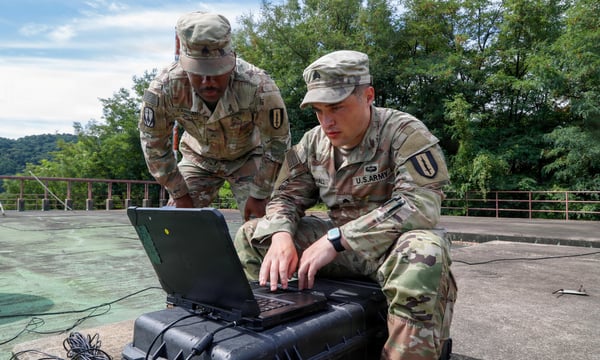

Soldiers assigned to the 304th Expeditionary Signal Battalion-Enhanced install and inspect communications equipment in support of Ulchi Freedom Shield at CP Tango in South Korea, Aug. 11, 2026.
How can allies using different AI systems on the same battlefield trust one another? While current discussions about military artificial intelligence (AI) focus on simply fielding these systems, allied militaries soon have to address this exact question.
In 2025, the Center for Strategic and International Studies (CSIS) and Scale AI tested seven major foundation models across 400 diplomatic and security scenarios. Despite being presented with identical international crises, the recommendations from the seven models diverged significantly. Some were uniquely hawkish, and every model exhibited some degree of national bias. This demonstrates that AI is by no means a homogenous tool.
Now these fractured algorithms are being integrated into many militaries on earth. We may be living through one of the final eras where an AI-equipped military might face an opponent operating without it. Before long, most global alliances will be thoroughly armed with AI – but each will be operating with a radically different version. Consequently, the real question is no longer who possesses AI, but rather, whether allies can trust different AI systems on the same battlefield.
Nations are already scrambling to secure interoperability between their chosen AI frameworks and those of their allies. The United States is rapidly strengthening AI-driven interoperability within its Indo-Pacific alliances. For instance, during the September 2025 Freedom Edge trilateral exercise between the United States, South Korea, and Japan, the nations demonstrated real-time data exchange by linking their respective simulation systems using AI tools.
The scope of these discussions is vast, ranging from real-time sensor integration and instant target identification to improving allied AI literacy. On the surface, this sounds like traditional alliance cooperation rhetoric, but beneath it lies cutting-edge military technology poised to reshape how coalition warfare operates.
The problem lies in what comes next. If every ally adopted Palantir’s Maven Smart System, for instance, integration would be relatively straightforward. However, with the rise of “AI sovereignty,” nations are parting ways on which AI-driven combat systems to adopt.
Japan has adopted a calculated two-track strategy, with summer 2026 being the watershed. Before June, under the Japan-U.S. alliance framework, Tokyo actively leveraged existing U.S. systems when necessary, while fostering domestic companies like SoftBank and Sakura Internet as the pillars of its sovereign AI infrastructure. Microsoft and Open AI’s recent investment signings with the aforesaid Japanese tech giants, while on a commercial basis, definitely seemed to be a signal that Tokyo would not rule out U.S. AI capabilities taking root in Japanese soil.
Perhaps the adoptions of Palantir-based solutions by Japanese firms, namely Fujitsu, was a harbinger of a bold change. As of mid-August, Japan is considering Palantir’s Maven Smart System as well as Anduril’s Lattice. The government, according to Nikkei, “envisions bringing in multiple AI systems” for the best operational decision-making, while using different systems for specific, tailored applications. This is best interpreted as a dual strategy that leverages U.S. technology while cultivating domestic industry to safeguard sensitive Self-Defense Force information and intelligence.
South Korea, by contrast, leans toward building systems based on independent technology rather than adopting U.S. platforms. With the government declaring 2026 as the year of the Defense AI Transformation, Naver recently launched a dedicated defense AI organization, entering the military market with its own foundation models and sovereign AI capabilities. Private-sector competition is heating up as SK Telecom and Hanwha Systems join the fray.
Meanwhile, the Philippines has yet to chart a clear direction. Lacking large domestic AI enterprises, it may quickly and boldly adopt foreign platforms like Palantir in the future.
Like any multilateral security initiative, this plan to connect disparate AI systems into a single, integrated decision-making structure demands a core requirement that must be met. Deploying and operating AI is one thing; accurately understanding the capabilities and limitations of an ally’s system is an entirely different matter.
The critical link is highly likely to be a concept that, despite its immense importance, has flown under the radar: the Risk Management Framework (RMF). Verification is required at two distinct levels. Traditional RMFs handle the security accreditation and interoperability standards of the middleware connecting different platforms. However, the newer, less familiar dimension of AI model trustworthiness is handled by an AI-specific layer within that framework – specifically, the National Institute of Standards and Technology (NIST) AI RMF. Though largely invisible, the AI RMF could become the true unsung hero that binds U.S.-made systems and indigenous allied AIs into a single, integrated network.
The aforementioned CSIS and Scale AI experiment highlights the issue: If models diverge this drastically in judgment, binding different AI systems into a single operation without verification is dangerous. Yet, forcing the same system onto everyone is impossible, as the reality of AI sovereignty is already pulling nations in different directions. Only one answer remains: permit the use of different models, but verify their trustworthiness using the same yardstick. That yardstick is the AI RMF developed by NIST specifically for AI.
Take a computer vision AI used for target identification as an example. In automated target recognition, the reliability of distinguishing threats from civilians, or friends from foes, is decisive in actual combat. A model that achieves 99 percent accuracy on a sunny training range cannot be trusted on the battlefield based on that metric alone.
The AI RMF fills this exact void by providing a framework that makes trustworthiness measurable and comparable. It quantitatively reveals how resilient the model is when an adversary attempts to deceive it via camouflage or spoofing. It shows how much identification accuracy degrades in environments outside its training data, such as fog or nighttime, and how reliability fluctuates under poor sensor data quality. This falls into the realm of inherent AI model trustworthiness – a domain untouched by standard cybersecurity checks.
The AI RMF does not simply give a system a passing stamp; it translates a system’s strengths and breaking points into actionable data that a commander can read. When this measured data accumulates, a Korean system and a U.S. system, for instance – even with entirely different internal architectures – can have their trustworthiness compared on the exact same basis.
This measurement matters not just for technical accuracy, but because it directly relates to whether humans can maintain genuine control over AI. When discussing autonomous systems, the phrase “human-in-the-loop” is frequently used. However, there is a vast difference between a human sitting in that loop as a mere formality and a human who substantively controls the system by understanding the rationale behind its judgments. Giving approval without knowing where an AI is reliable and where it is likely to make mistakes is not meaningful control; it is rubber-stamping. The trustworthiness data generated by the AI RMF provides commanders with that necessary understanding of the system’s strengths and weaknesses. A truly trustworthy AI is, ultimately, an AI that a human can control based on evidence.
The necessity of the AI RMF extends even further. In the current rush to field AI on the battlefield, it is easy to miss the fact that you cannot have maximum performance and maximum security simultaneously. Making an AI highly resilient against enemy deception often blunts its speed and accuracy; conversely, pushing solely for raw performance leaves the system vulnerable to manipulation. Gaining ground on one side requires sacrificing some on the other. The AI RMF quantifies this trade-off by showing exactly where each system stands between security and performance.
At this juncture, the AI RMF transcends individual system verification to become the common language of the alliance. When integrating different AI systems into a single operation, nations can look at the measured data and mutually agree on where to set the baseline of trust for a specific coalition mission. Determining that balance remains a human responsibility, but without these measurements, such an agreement becomes a baseless compromise.
In its June 5, 2026, National Security Presidential Memorandum (NSPM-11), the United States established its national security AI policy on four pillars: adoption, adaptation, assurance, and accountability. Among these, “assurance” dictates that deployed AI must be reliable, robust, steerable, and controllable. The memorandum explicitly directed the creation of standardized Test, Evaluation, Verification, and Validation methodologies for national security AI. The message is clear: even the fastest-moving nation has begun treating verification not as a bureaucratic formality that delays adoption, but as a prerequisite that enables integration.
This shift went beyond policy declarations. In early June 2026, DARPA, NSF, and NIST’s Center for AI Standards and Innovation (CAISI) jointly launched AI Forge, a national program devoted to building the assurance foundations of national-security AI: interpretability, control, adversarial robustness, and credible, verifiable benchmarks. If NSPM-11 set “verified AI” as a policy principle, AI Forge began building the technical foundation to actually make that verification possible – and the fact that NIST anchors one of its pillars reinforces the argument that AI RMF can become the common yardstick binding allies together.
If allies cannot trust each other’s AI, they cannot fight together. This is the low-profile yet essential foundation that the AI RMF provides. Allies will succeed only when each nation can verify the other’s AI against a common standard of trust – and continue to verify those systems as they evolve.