
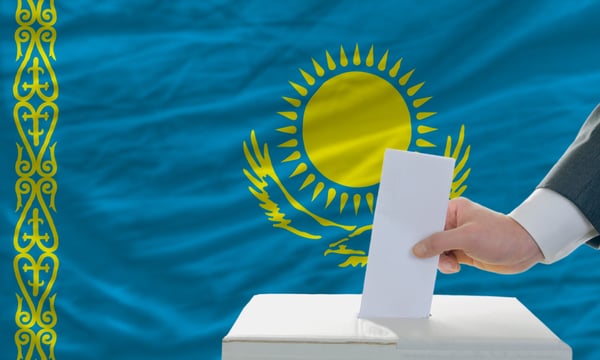

On August 23, Kazakh citizens will head to the polls to cast votes for the country’s new legislative body, the 145-seat unicameral Kurultai.
The Kurultai – not to be confused with the National Kurultai, a government-civil society consultative body formed by Kazakh President Kassym-Jomart Tokayev in 2022 after the Qandy Qantar events and dissolved this summer – was established with the passage of the constitutional referendum in June. Named for a traditional political and military council convened by Mongol and Turkic peoples, Kazakhstan’s new Kurultai replaces its previous bicameral parliament.
The shape of the Kazakh legislature may have changed, but the politics of Kazakhstan have not necessarily been transformed.
There are seven political parties contesting the elections following the June 12 merger of Amanat – the ruling party, formerly known as Nur-Otan – with the upstart Adilet. While opposition political parties have struggled in vain for years to obtain registration, the newly formed Adilet raced from nonexistence to registration in record time. Importantly, Aibek Dadebay, very recently the head of the presidential administration, is the party’s head.
In the previous 98-seat lower house, the Majilis, Amanat secured 62 seats in the 2023 election. No other party came close: Auyl held eight seats, Respublica and Aq Jol held six each, the People’s Party of Kazakhstan (QHP) held five, and the Nationwide Social Democratic Party (JSDP) held four seats.
Adilet is expected to dominate in the upcoming polls. Is this just old wine in a new bottle? Perhaps. The genuine test is what comes after the election: how the new legislature operates and whether there is not just room for genuine debate but actual debate in that room. If the legislature serves, as its predecessors have, as merely a rubber stamp on the president’s projects then indeed Kazakhs will be sipping an ancient vintage once again.
According to Kazakhstan’s Central Election Commission (CEC), as of July 23, it had registered 545 candidates for the 145 seats. The 2023 election operated under a mixed system for the first time since 2004, in which 69 seats were allocated via party-lists and 29 by constituency. This year, all 145 seats in the Kurultai will be elected via proportional representation according to party lists. This heightens the importance of parties, but absent new parties this may just serve as a non-electoral limit on who can participate in governance.
Mere days ahead of the election, major Kazakh media outlets – those not directly under state control – are carrying very little that can be construed as election coverage. Vlast and Tengrinews, for example, both reported on the free public transport being offered on August 23 in Almaty and Astana. There are also reports on the number of election observers registered. There are few (if any) reports on the platforms being put forward by the individual parties.
Reports in state media slot each party into a natural constituency without offering much detail about how those parties approach universal problems. Auyl – the Kazakh word for “village” – “focused on agricultural development and rural communities,” according to the Astana Times. Aq Jol and Respublica “continued to compete for entrepreneurs and economically liberal voters, with both parties emphasizing business development and market-oriented reforms.”
Kazakhstan’s non-state media also carried reports on a statement issued by a constellation of human rights organizations calling on the Kazakh government to cease its persecution of and pressure on journalists and media outlets ahead of the election. The signatures included the International Foundation for the Protection of Freedom of Speech “Adil soz,” the Kazakhstan International Bureau for Human Rights and Rule of Law, the Norwegian Helsinki Committee, the Committee to Protect Journalists (CPJ), Araminta, Civil Right Defenders, Crude Accountability, Freedom For Eurasia, and the International Partnership for Human Rights.
In the August 14 statement, the human rights organizations directed attention to the arrest in July of political commentator Azamat Omarov; the travel bans against Lukpan Akhmedyarov and Dinara Yegeubayeva, who are both under investigation for separate incidents rife with irregularities ; and the sentencing of journalist Aleksandra Alyokhova to three years following her conviction under a data privacy law.
“These cases form part of a broader, longer-term pattern of increasing pressure on independent media and journalists in Kazakhstan, including the use of politically motivated charges, online restrictions on access to information, and other forms of harassment and intimidation against those who criticize the authorities,” the statement argued.
Kazakhstan’s Minister of Culture and Information, Aida Balayeva, appeared to respond to the statement with a lengthy Facebook post on August 17, though she primarily focused on “information being disseminated about the alleged mass blocking of a number of media accounts, activists, and bloggers.”
Balayeva reiterated that Kazakhs have an “indisputable right to carry out journalistic and blogging activities.”
“The Ministry of Culture and Information does not block social media user accounts, including those of media outlets and journalists. Such actions are a clear tool for discrediting the state and its institutions and are aimed at hindering the ministry’s efforts to ensure freedom of speech,” Balayeva wrote.
Balayeva stressed that the right to speech is paired with a responsibility to accuracy.
“At the same time, it is crucial to clearly distinguish between illegal materials and legitimate expression of opinion, professional journalistic activity, and public debate. The fight against illegal content should not become a basis for unjustified restrictions on freedom of speech,” Balayeva wrote.